| Pace | Notice how the action scenes use short, fragmented sentences to speed up the reader's heart rate. |
| Plot | The plot is driven by the tension between Jack’s desire for stability and the group’s need for growth. |
| Prosody | Encourage students to read the dialogue with the 'voice' of a teenager—fast, informal, and often humorous. |
| Word Pause | Look for single-word sentences or lines that stand alone to emphasize a sudden realization or shock. |
| Concept | The core concept is 'video-game-logic' applied to real-life survival. |
| Voice & World View | Jack’s voice is consistently that of a kid trying to act brave while feeling insecure. |
| Setting & Place | The treehouse is a character itself; notice how its description changes as the threat level rises. |
| Point of View | The first-person perspective keeps the reader trapped in Jack’s limited, often biased, understanding of the world. |
| Original Characters | Each character has a specific 'class' or role (e.g., Quint as the inventor) that defines their contribution. |
| Dialogue | Dialogue is used to establish the banter and history between the four friends. |
| Details | Focus on the specific brands or items (like Oreos) that ground the fantasy in a recognizable reality. |
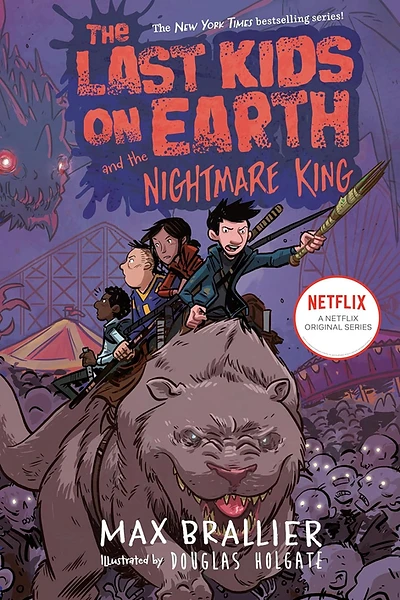
| Descriptions | Descriptions are often paired with illustrations; notice how the text describes the 'feel' while the art shows the 'look.' |
| Strong First Lines | The opening lines immediately establish the 'new normal' of the apocalypse. |
| Immediacy & Engagement | The book uses direct address to the reader to make them feel like part of the crew. |
| Story Scenes & Summaries & Unique Structures | The book alternates between traditional prose and comic-style panels to break up the narrative flow. |
| Flashback & Flash Forward & Cliffhangers | Cliffhangers are used at the end of almost every chapter to force the reader to turn the page. |
| Tension & Suspense & Surprise | Tension is built by the looming threat of the Nightmare King, which is always present in the background. |
| Page Turns and Chapter Breaks | Chapter breaks are strategically placed to maximize the impact of a reveal. |
| Performance | The text is written to be read aloud with high energy and dramatic pauses. |
| Personality | Jack’s personality is defined by his humor, which he uses as a defense mechanism. |
| Humor | Humor is used to deflate the tension of scary situations, making the apocalypse feel manageable. |
| Pause | Use the illustrations as a 'visual pause' to let the reader catch their breath after an action sequence. |
| Poetry and Poetic Devices | Look for onomatopoeia in the action scenes (e.g., 'KRAK!', 'BOOM!'). |
| Repetition | Repetition of the 'rules' of the apocalypse helps reinforce the world-building. |
| Rhythm | The rhythm of the prose mimics the fast-paced nature of the video games Jack loves. |
| Punctuation | Frequent use of exclamation points and dashes creates a sense of urgency and excitement. |
| Questions | Jack often asks rhetorical questions to the reader to build intimacy. |
| Compare-Contrast | Compare Jack’s life before the apocalypse to his life now. |
| Objects | Objects like the sword or the treehouse are symbols of the characters' identities. |
| Threes | Look for lists of three items or actions that create a satisfying cadence. |
| Whitespace & Negative Space | The layout uses whitespace to make the text feel less dense and more accessible. |
| Art & Graphics | The art is not just decoration; it is essential for understanding the scale of the monsters. |
| Interactives & Gamification | The book includes 'game-like' elements such as monster stats and level-ups. |